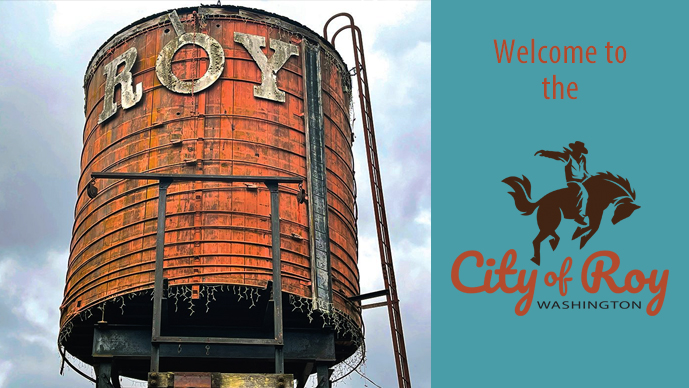
Welcome to the City of Roy!
City News & Announcements
Facebook Posts

The City Of Roy, WA. - Government is currently seeing Two (2) dedicated volunteers to serve as commissioners for the City of Roy Planning Commission. The Planning Commission is an integral part of City Government and future of building & zoning within the City of Roy.
"The planning commission provides citizen review and recommendations on planning related matters to the city, town, county council or board of commissioners.
Planning commissions often have two distinct functions. The first involves preparation and revision of the communities comprehensive plan and local land use regulations, such as the zoning and subdivision code. The Second, and frequently most time consuming functions involves review of development proposals, such as site plans and subdivisions."
If you have any questions or would like to apply, please reach out to RoyCityHall@CityOfRoyWA.US or call 253-843-1113.
The City Of Roy, WA. - Government is excited for our Annual Community Clean-Up and Hometown Hero Celebration!
In partnership with Joint Base Lewis-McChord 555 Engineer Brigade (Triple Nickel), Waste Connections of Washington, Inc., Roy Grange 702 the Nisqually Indian Tribe, Washington Department of Ecology and more, the volunteers will work to clean up community areas, offer waste dumping (on a first come, first serve basis at one load per household) in large waste containers for those who live within Roy City Limits and pay for Roy City Utilities.
Come volunteer your time to help make our community beautiful! Be the change that you want to see in your City.
Following the community cleanup from 8am to approximately 12pm, the Roy Grange 702 and Roy Lions Club will be hosting a BBQ in the Park prior to the announcement of our 2024 Hometown Heroes!
These Hometown Heroes will be celebrated for the 2024 year and displayed to the community outside Roy City Hall! Their dedication and involvement in the City are truly a gift that deserves recognition!
Please direct your questions to RoyCityHall@CityOfRoyWA.US or feel free to call 253-843-1113.
We hope to see everyone there!
We're hosting a Passport Fair for people seeking first time passports. Join the Thurston County Auditor's Office, the City of Seattle Government Passport Agency, and my office to get ready for summer travel.
Have questions? Call my office at 360-459-8514.
Read more: www.thurstoncountywa.gov/departments/auditor/passports
Make sure to check out our latest Roy City Council meeting from 4/8/2024!
During this meeting, council discusses Ordinance 1016 and Resolution 964 alongside final appointment potential for council seat #1 and potential certification of 2 planning commission positions. Additionally we were joined by Bethel School District for an update on the new high school!
Events This Month
-
- Council Meeting Monday, May 13th, 7pm at City Hall
ALL are welcome to attend in person or online - Planning Commission Meeting Tuesday, May 21st, 6pm at City Hall
- City & County Meet & Greet – Old Roy Gym @ 6:00 pm.
- Nourish Food Bank – Calvary Baptist Church, 9010 320th St S, – Wednesdays 1-3pm
- Roy Lions Club meetings are every 3rd Tuesday 7pm at the Roy Grange
- Council Meeting Monday, May 13th, 7pm at City Hall
City Updates
-
- The City of Roy is currently searching for TWO (2) Planning Commissioners to sit on the City of Roy Planning Commission. If you are interested feel free to fill out an application on our website or reach out for more information to Michael Malek at RoyCityHall@CityofRoyWA.US
- Don’t miss out on the Pierce County & City of Roy Meet & Greet on Wednesday, April 17th at the Old Roy Gym! Pizza will be provided!
- Council members receive email through the City’s general address RoyCityHall@CityofRoyWA.us. Please indicate in the subject line the intended recipient(s).
- Regular meetings are held on the 2nd Monday of every month starting at 6:30pm (a combined work/study session) and the Regular Council Meeting starting at 7pm.
- Study Sessions: 6:30pm prior to Regular Meetings

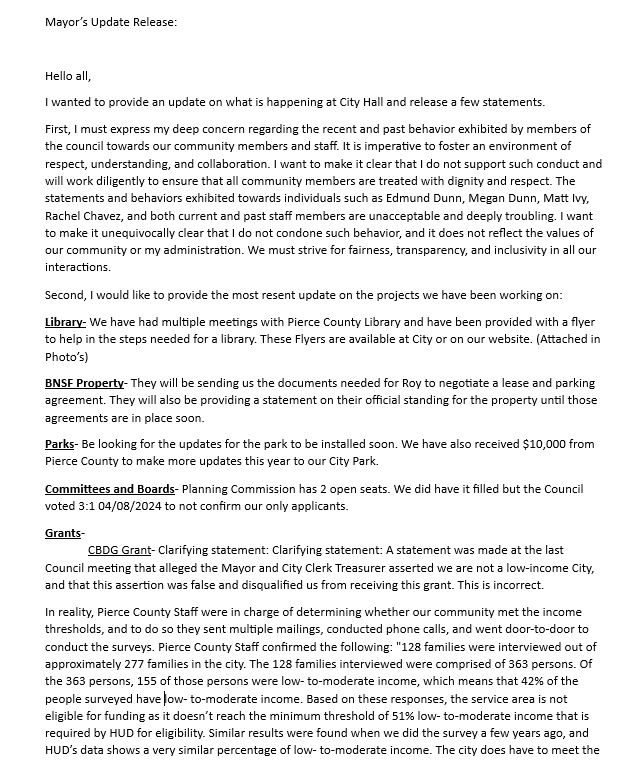
An Open Letter from Mayor Kimber Ivy – City of Roy, WA.
“
Hello all,
I wanted to provide an update on what is happening at City Hall and release a few statements.
First, I must express my deep concern regarding the recent and past behavior exhibited by members of the council towards our community members and staff. It is imperative to foster an environment of respect, understanding, and collaboration. I want to make it clear that I do not support such conduct and will work diligently to ensure that all community members are treated with dignity and respect. The statements and behaviors exhibited towards individuals such as Edmund Dunn, Megan Dunn, Matt Ivy, Rachel Chavez, and both current and past staff members are unacceptable and deeply troubling. I want to make it unequivocally clear that I do not condone such behavior, and it does not reflect the values of our community or my administration. We must strive for fairness, transparency, and inclusivity in all our interactions.
Second, I would like to provide the most resent update on the projects we have been working on:
Library- We have had multiple meetings with Pierce County Library and have been provided with a flyer to help in the steps needed for a library. These Flyers are available at City or on our website. (Attached in Photo’s)
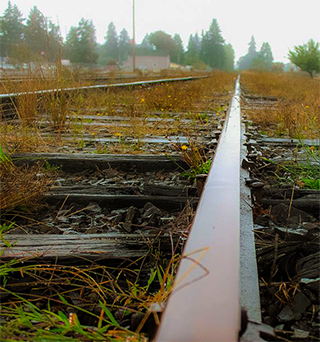
BNSF Property– They will be sending us the documents needed for Roy to negotiate a lease and parking agreement. They will also be providing a statement on their official standing for the property until those agreements are in place soon.
Parks– Be looking for the updates for the park to be installed soon. We have also received $10,000 from Pierce County to make more updates this year to our City Park.
Committees and Boards– Planning Commission has 2 open seats. We did have it filled but the Council voted 3:1 04/08/2024 to not confirm our only applicants.
Grants–
CBDG Grant– Clarifying statement: Clarifying statement: A statement was made at the last Council meeting that alleged the Mayor and City Clerk Treasurer asserted we are not a low-income City, and that this assertion was false and disqualified us from receiving this grant. This is incorrect.
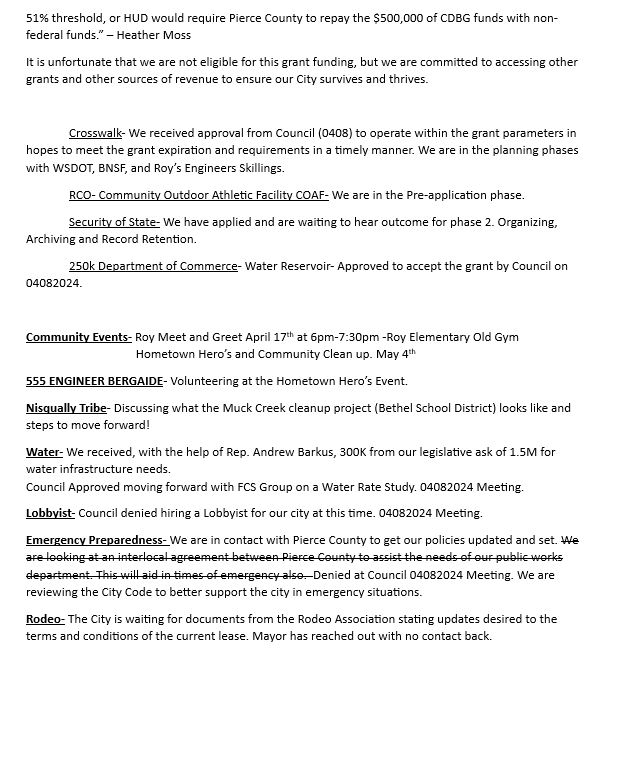
In reality, Pierce County Staff was in charge of determining whether our community met the income thresholds, and to do so they sent multiple mailings, conducted phone calls, and went door-to-door to conduct the surveys. Pierce County Staff confirmed the following: “128 families were interviewed out of approximately 277 families in the city. The 128 families interviewed were comprised of 363 persons. Of the 363 persons, 155 of those persons were low- to-moderate income, which means that 42% of the people surveyed are low- to-moderate income. Based on these responses, the service area is not eligible for funding as it doesn’t reach the minimum threshold of 51% low- to-moderate income that is required by HUD for eligibility. Similar results were found when we did the survey a few years ago, and HUD’s data shows a very similar percentage of low- to-moderate income. The city does have to meet the 51% threshold, or HUD would require Pierce County to repay the $500,000 of CDBG funds with non-federal funds.” – Heather Moss
It is unfortunate that we are not eligible for this grant funding, but we are committed to accessing other grants and other sources of revenue to ensure our City survives and thrives.
Crosswalk– We received approval from Council (0408) to operate within the grant parameters in hopes to meet the grant expiration and requirements in a timely manner. We are in the planning phases with WSDOT, BNSF, and Roy’s Engineers Skillings.
RCO- Community Outdoor Athletic Facility COAF- We are in the Pre-application phase.
Security of State- We have applied and are waiting to hear outcome for phase 2. Organizing, Archiving and Record Retention.
250k Department of Commerce– Water Reservoir- Approved to accept the grant by Council on 04082024.
Community Events- Roy Meet and Greet April 17th at 6pm-7:30pm -Roy Elementary Old Gym
Hometown Hero’s and Community Clean up. May 4th
555 ENGINEER BERGAIDE– Volunteering at the Hometown Hero’s Event.
Nisqually Tribe– Discussing what the Muck Creek cleanup project (Bethel School District) looks like and steps to move forward!
Water- We received, with the help of Rep. Andrew Barkus, 300K from our legislative ask of 1.5M for water infrastructure needs.
Council Approved moving forward with FCS Group on a Water Rate Study. 04082024 Meeting.
Lobbyist- Council denied hiring a Lobbyist for our city at this time. 04082024 Meeting.
Emergency Preparedness- We are in contact with Pierce County to get our policies updated and set. We are looking at an interlocal agreement between Pierce County to assist the needs of our public works department. This will aid in times of emergency also. Denied at Council 04082024 Meeting. We are reviewing the City Code to better support the city in emergency situations.
Rodeo- The City is waiting for documents from the Rodeo Association stating updates desired to the terms and conditions of the current lease. Mayor has reached out with no contact back.”
– Mayor Kimber Ivy
A Note From The Roy Historical Cemetery
The Executive Team at the Roy Historical Cemetery would like to THANK our community for for the support you have shown over the last 13 days. We asked you to sponsor wreaths to be laid at veterans headstones and y’all came out in force! In 13 days you helped us by sponsoring 151 wreaths!
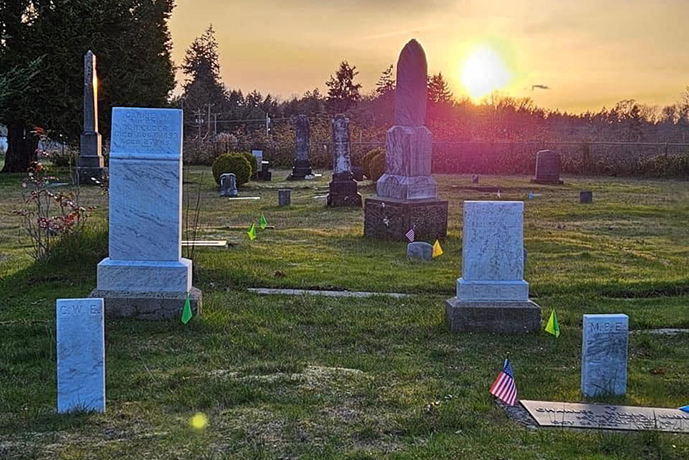
We are humbled and we are grateful to be a part of a such an amazing community that supports and loves our little historical cemetery as much as we do! Thank you again!!!!!
Beth King Owner/President
Jeri Carrano-Setzer – Vice President
Angela Rexroad – Secretary
Shannon Faria – Treasurer
P. S. – Volunteer information coming soon!!!!! Reserve December 14, 2024 for the Roy Historical Cemetery Wreaths Across America ceremony!!! We would LOVE to have one volunteer for each Veteran for our ceremony!!! Scout troops, church groups/congregations, families, neighbors, HOA’s, school reunions, PTA’s, BUNCO members, civic organizations, individuals, friends, ball teams, work groups (great team building activity), etc! I could go on and on, use your creativity!!! Let’s honor each one with personalized service!!!!
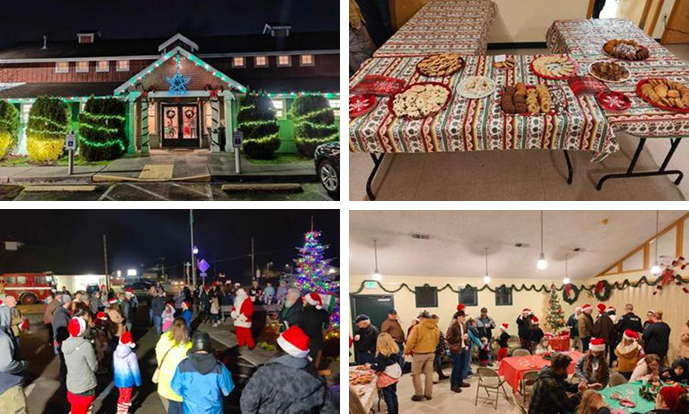
Roy’s Annual Tree Lighting Event 2023
We want to thank everyone that participated in our tree lighting ceremony! It was truly a wonderful time.
Special thank you to Santa, Triple Nickle, Roy Grange, Roy Lion’s Club, Pastor Bill Wagner, LeMay Refuse for the bike donations and the many staff and community members that volunteered their time to decorate and provide the delicious cookies and treats. This was an amazing success!
Press Release: Statement Clarification Regarding Nisqually Valley News Articles
The City of Roy has released a statement regarding allegations raised during prior City Council Meetings. The articles the statement responds to are, “Letter to the Editor – Roy City leaders must answer for finances” dated 10/17/2023 and “City of Roy Uncovers Financial Discrepancies as Mayor, City Clerk Treasurer Resign” article dated 3/30/2023. Here is the official press release.
Pierce County Alert
In case of an emergency within Roy City Limits, please go to https://www.piercecountywa.gov/921/Pierce-County-ALERT for all updates and watch the City of Roy website for additional information and guidance.

 We Are On Facebook!
Are you following us on Facebook?!? Make sure to give us a like and follow for the most up to date and accurate information on the City of Roy straight from the source! https://www.facebook.com/CityOfRoyWA
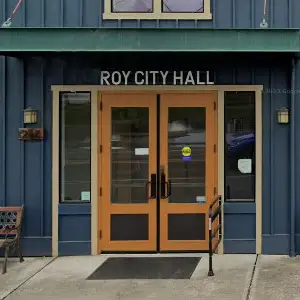
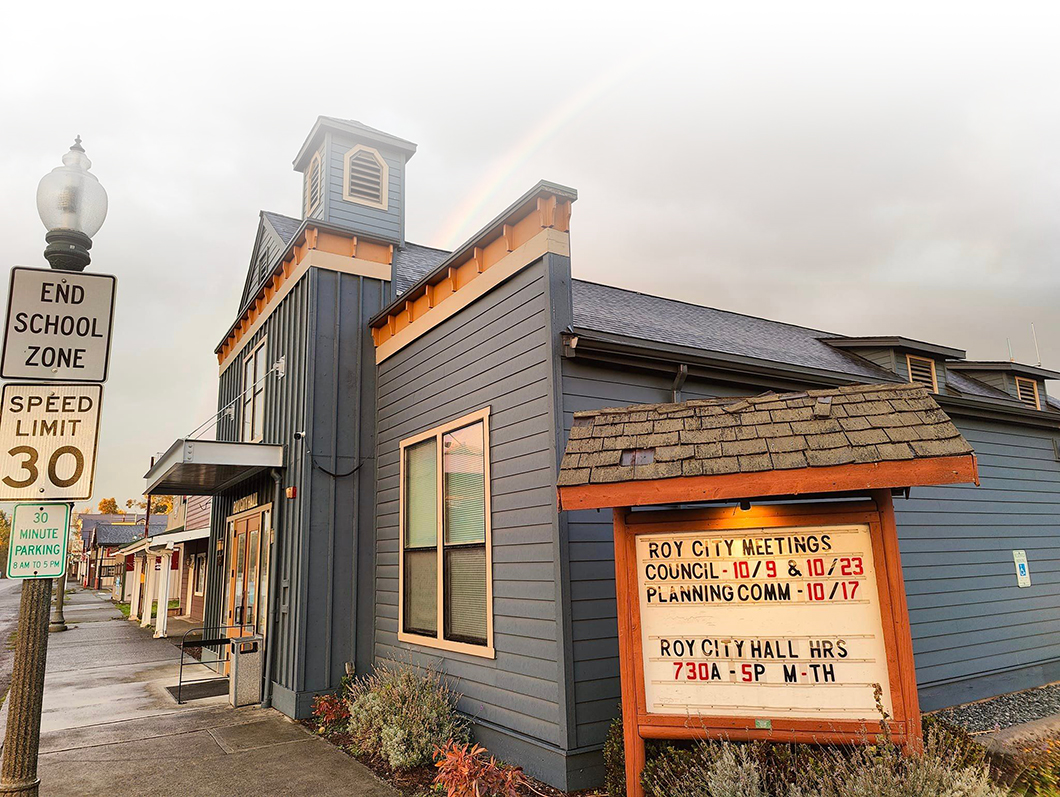
City Hall Hours:
7:30am - 5pm, Mon - Thu
253-843-1113
RoyCityHall@CityofRoyWA.us
City Clerk Office:
7:30am - 5pm, Mon - Thu
Court Office:
8:30am - 2pm, MTTF
(Closed Wednesdays)
City of Roy
216 McNaught St S
PO Box 700
Roy, WA 98580-0700
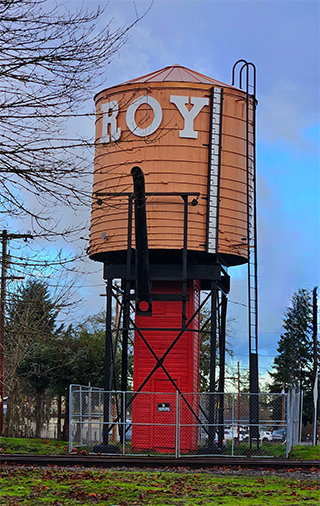
Photo of the Roy Water Tower restored by the Save The Roy Water Tower Committee taken by local resident Angela Rexroad



The City of Roy is located at
Latitude: 47°0′12″ N
Longitude: -122°32′ 23.39″ W